Reflections on “Advancing Research Capacity”
What did this ARC Residency mean to you and your practice?
The residency was critical in helping me figure out the final effects, edits, and outcome for the video performance of my recent project Asterisms of a Seeded Ghost (2026). Through video editing and effects, and projection mapping, my time in the residency opened up elements within my work that I had not previously considered and was able to expand my work in a way that I would not have previously considered possible.
Describe what you did during your residency?
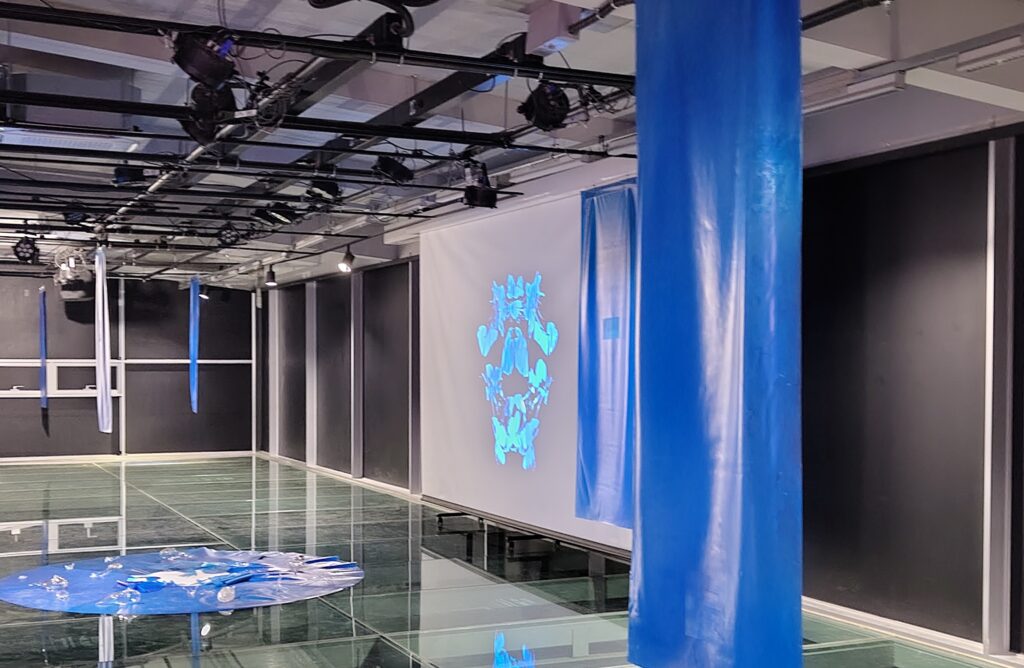
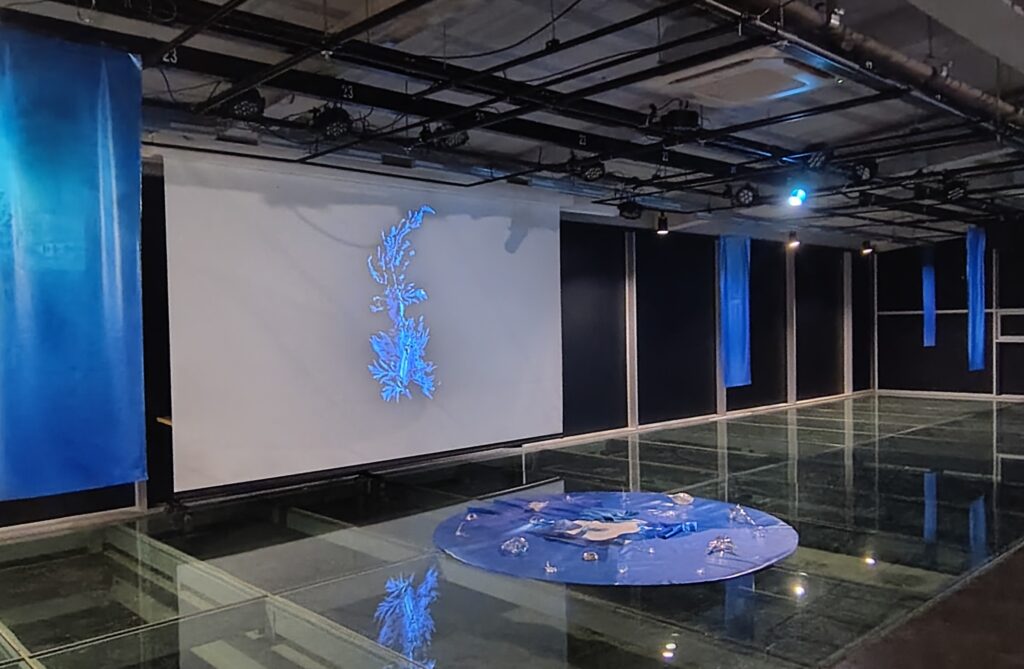
I arrived at the residency with some glass and biomaterial sculptures to test out projection mapping with the great technical support of Jack Chipman. It was surprising how quickly my project pivoted from mapping out objects to playing with video edits and after effects, animating plant illustrations and learning the morphing tool’s capacity (and limitations). The three working days went by in a blur as we worked until the final minutes. The video ultimately became a critical part of my overall installation and connected the conceptual frameworks of the work through its formation.
The work, Asterisms of a Seeded Ghost (2026), considers how the body moves through conditions of visibility, surveillance, and inheritance. The work takes the form of a speculative cloaking device inspired by celestial navigation and the ssugaechima, a Korean garment worn by women during the Joseon Dynasty to shield their bodies in public space. Reimagined as a seeded, biodegradable interface, the cloak offers protection while maintaining ties to ancestral memory and ecological relations. Its circular form wraps around the wearer like a living map, tracing connections between land, sky, migration, and memory.
Embedded seeds travel with the body alongside coded constellations pressed into the material’s surface, imagining future acts of wayfinding and return. Made from biomaterials derived from traditional Korean medicinal plants and diasporic species, the work carries both the experience of displacement and the possibility of taking root elsewhere. Suspended throughout the installation are translucent blue biomaterial sheets etched with photographs of Korean beauty salons, spas, and other sites of feminized care work. These spaces have long functioned as infrastructures of care, survival, and community within the diaspora, while also carrying the tensions of racialized and gendered violence directed toward Asian women. The images appear as spectral traces within the blue surfaces, holding histories of labor, resilience, vulnerability, and collective care.
The video portion of work extends these questions through Korean diasporic plants that continuously morph and hybridize into new forms. As one plant dissolves into another, figures emerge within blue-screen interiors, performing gestures of counterclockwise spinning, unfurling, concealment, and withdrawal. Occupying a space between visibility and disappearance, these bodies suggest ways of remaining present without becoming fully legible. The blue screen functions as a site of transition and possibility, echoing the blue biomaterials that permeate the installation and linking bodies, plants, memory, and transformation. Throughout the work, opacity operates as a form of protection, allowing movement, relation, and survival outside demands for complete visibility. As the biomaterials gradually decompose, they return to the earth as nutrient-rich matter capable of supporting new growth. The installation imagines belonging as an ongoing process of navigation, adaptation, and rooting across generations, landscapes, and living systems.
What is next for this work and/or practice?
The work developed during this residency has opened a longer investigation into biomaterials as carriers of diasporic memory, ecological knowledge, and embodied forms of resistance. Moving forward, I am interested in further expanding the relationships between seaweed-based materials, Korean medicinal and migratory plants, and histories of movement across the Pacific. This includes deepening research into how living and biodegradable materials can function as archives that hold traces of migration, care work, and cultural inheritance while remaining responsive to environmental conditions. I am also continuing to develop fabrication methods that allow these materials to transform over time, embracing processes of growth, decay, and renewal as part of the work itself.
The residency has also generated new questions around visibility, opacity, and wayfinding that I plan to pursue through installation, moving image, and performative forms. In particular, I am interested in expanding the visual language of my practice by developing larger networks of etched biomaterial archives, researching diasporic sites of care and labor, and creating new video works that explore hybrid plant ecologies as living metaphors for migration and adaptation. Ultimately, this research is moving toward a broader body of work that examines how bodies, plants, materials, and ancestral knowledge travel together, creating alternative maps of belonging that emerge through relation, transformation, and collective survival.